
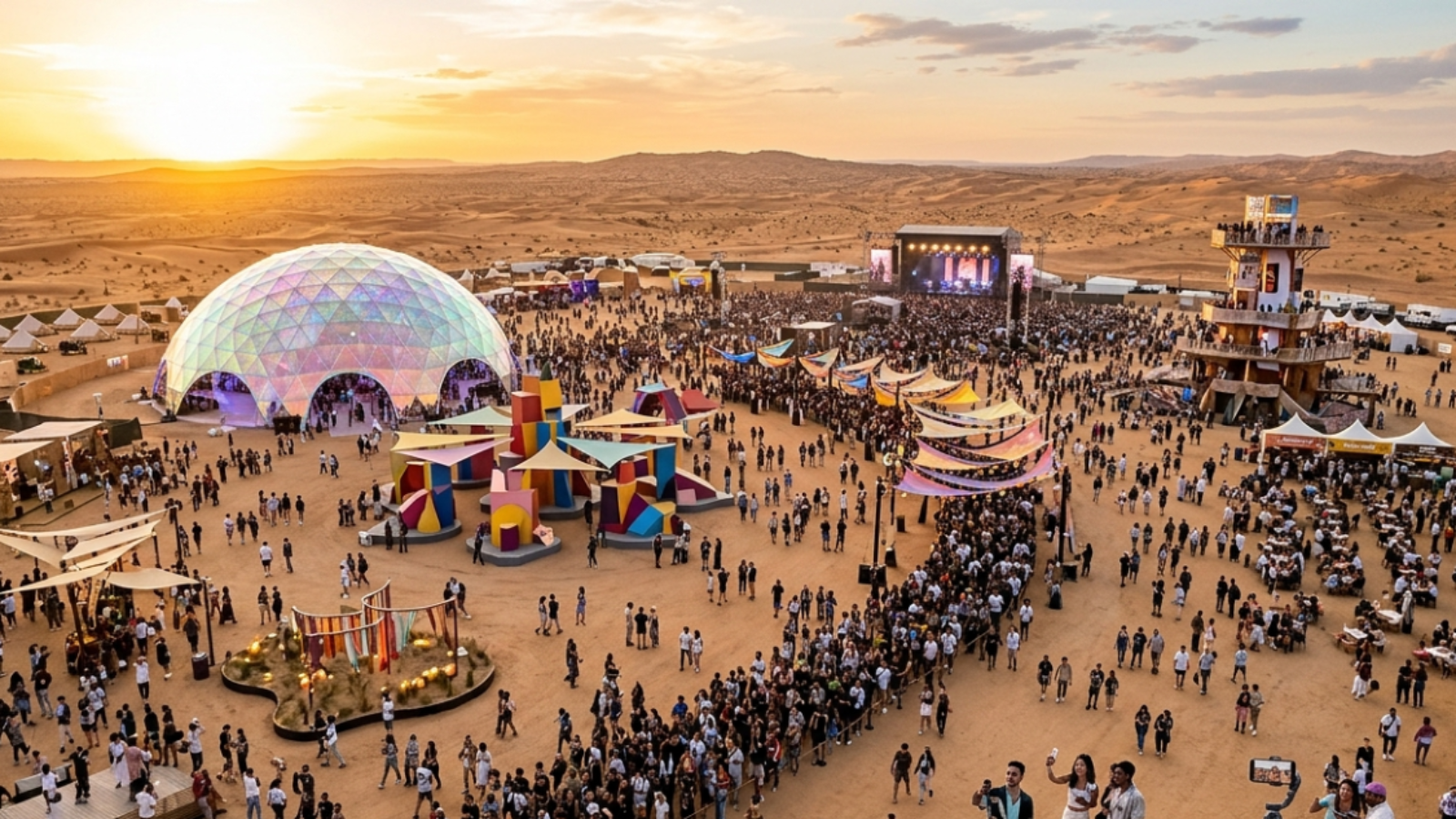
The headline acts at Coachella 2026 were Lady Gaga, Green Day, and Post Malone. But the real show was what the brands built in the desert.
When the Sponsor Became the Headliner
There is a moment every April when the internet does something interesting. For two consecutive weekends, social media fills with more than concert clips and outfit posts. It becomes a stream of branded experiences that nobody seems to treat as advertising. Queues outside branded pop-ups. Influencers holding limited-edition cups. Slow-motion videos of scented bubbles being sprayed into a crowd. Photo booths with two-hour lines.
Welcome to Brandchella. Welcome to Brandchella, the internet’s nickname for the unofficial festival that runs alongside Coachella every April in Indio, California. Here, some of the world’s biggest brands spend millions creating experiences that attendees cannot resist sharing. Most festivalgoers are under 35 and bring audiences of their own.
In 2026, brand activations at Coachella reached a new level of sophistication. Brands were not just sponsoring stages or handing out samples. They were building worlds, solving real problems, creating memorable experiences, and generating earned media that far exceeded the impact of traditional advertising . The estimated earned media value from Rhode Skin’s activation alone crossed 2.63 billion dollars.
This blog breaks down the brands that won Coachella 2026, why they won, what the underlying strategy was in each case, and what every business, large or small, can take from the desert into their own marketing.
Why Coachella Is the Most Valuable Marketing Stage Right Now
Before diving into the specific activations, it is worth understanding why Coachella commands the attention it does from marketing teams globally. The answer is not simply that it is a famous music festival. It is the specific nature of its audience and their behaviour.
Gen Z makes up approximately 40 percent of Coachella’s attendance. These are not passive consumers. They are active content creators who arrived at the festival with cameras, with audiences, and with the social instinct to document and share every experience that is worth sharing. A brand that creates something genuinely worth sharing at Coachella does not just reach the 125,000 people in the desert. It reaches their combined following, which runs into the tens of millions.
The festival has also become what marketing professionals are calling the Super Bowl of experiential marketing. Where the Super Bowl offers brands thirty seconds on a screen, Coachella offers an immersive physical experience that lasts hours, produces user-generated content organically, and reaches an audience that is actively looking for new things to be excited about.
The Activations That Won the Weekend
Rhode and 818 Tequila: The Photo Booth That Earned 2.63 Billion in Media Value
Rhode Skin, the beauty brand founded by Hailey Bieber, returned to Coachella 2026 with a photo booth activation that sounds deceptively simple. Attendees could use a coin to unlock a vending machine, receive a freebie, and take a photo. In collaboration with 818 Tequila, owned by Kendall Jenner, the activation fused beauty and beverage culture in a single, highly photogenic experience.
What made it work was not the mechanic. It was instinct. The activation understood that at Coachella, the photo is the product. Every person who stood in that photo booth queue was waiting not just for a freebie but for a piece of content they could post. Rhode designed the entire experience around the moment of capture, from the lighting to the backdrop to the physical format of the coin and the machine. The result was 2.63 billion dollars in estimated earned media value, making it the highest-performing beauty and wellness activation at the festival.
Method: Turning a Festival Pain Point Into a Brand Moment
The personal care brand Method was the official personal care sponsor of Coachella 2026, and their approach to that partnership was a masterclass in social listening and real-time marketing. When a creator posted a viral video about the extraordinarily long shower queues at the festival campgrounds, Method responded within hours. Their team arrived at the queue and surprised disgruntled attendees with shower upgrade tickets, VIP festival passes, and free products. They also deployed scented bubble machines that floated through the crowds, keeping attendees cool, fresh, and extremely willing to film and share the experience.
Over the course of the weekend, Method distributed more than 100,000 product samples. But the more important number is the viral video that triggered the entire sequence. A piece of content that had nothing to do with Method became the brief for their most memorable activation of the year because their team was watching, listening, and ready to move.
Sol de Janeiro: Making History as Coachella’s First Fragrance Partner
Brazilian body care brand Sol de Janeiro made history at Coachella 2026 as the festival’s first official fragrance and body care partner. Its activation, Casa Cheirosa, was a sensory installation featuring six immersive scent zones inspired by the brand’s signature fragrances. At the centre stood reimagined Brazilian phone booths transformed into fragrance portals, allowing visitors to experience the products in a memorable and interactive way.
The activation solved a challenge unique to fragrance marketing: people cannot smell a video. By creating a physical sensory experience that attendees wanted to film and share, Sol de Janeiro turned an offline product experience into highly shareable content. The result was one of the festival’s most talked-about branded activations.
Pinterest: Making the Unofficial Official
Pinterest has long been the unofficial mood board platform for Coachella style. Every year, searches for festival outfit ideas spike dramatically in the weeks before the event. In 2026, Pinterest formalised that relationship with a desert circus activation where on-site stylists helped festivalgoers remix their outfits using trending looks from the platform. Collage artist Ramisha Sattar guided visitors through the experience, turning Pinterest’s search data into a live, interactive style consultation.
The strategic insight here is important: Pinterest did not need to manufacture relevance at Coachella. The relevance already existed. What they did was step into that relevance with a physical experience that made explicit what had previously been implicit. They were the brand that helped you dress for this moment. The activation simply made that true in a tangible, shareable way.
Heineken House: The Power of Consistent Energy
Not every successful activation at Coachella required a viral moment or a record-breaking media value figure. Heineken House demonstrated that consistency and curation are their own form of brand strategy. Set inside a vinyl-inspired dome, the space featured a curated lineup of live DJs including Pusha T and Channel Tres, a bar, a dance floor, and a lounge. The layout was deliberately simple. But the atmosphere it created was fully immersive, with its own crowd, its own energy, and a reason to stay that went beyond branded signage.
Heineken House works year after year not because it reinvents itself dramatically but because it delivers reliably. In a festival environment full of brands desperately trying to be surprising, sometimes the most sophisticated move is to be the space people know will always be worth visiting.
What Is Actually Going Wrong in Festival Marketing
The Logo Tent Problem
For every Method and Rhode at Coachella, there are dozens of brands that show up, put their logo on a tent, hand out some product samples, and wonder why nobody talked about them. The logo tent approach fundamentally misunderstands what the festival audience is there for. They are not looking for advertisements. They are looking for experiences. A brand that shows up as an interruption will always lose to a brand that shows up as an addition to the experience.
The Exclusivity Trap
Some brand activations at Coachella are so exclusive that the only people who experience them are the influencers who were flown in specifically to post about them. This creates a strange loop where the authenticity that makes festival content compelling is entirely manufactured. Audiences are increasingly able to detect when an activation exists purely for content creation rather than for the people supposedly attending it, and that detection erodes the trust that makes influencer endorsements effective in the first place.
What Indian Brands Can Learn From Brandchella
You Do Not Need Coachella, You Need the Indian Version of Coachella
NH7 Weekender, Sunburn, Lollapalooza India, and Ziro Festival attract the same kind of culturally engaged, content-creating audiences that make Coachella so valuable. Brands that show up with meaningful experiences instead of just sponsor logos are building cultural relevance in India just as Rhode did at Coachella. The opportunity is enormous and the competition, compared to Coachella, is still relatively thin.
Solve a Real Problem and Own the Moment
Method’s greatest lesson for Indian brands is that the best activation ideas come from paying attention to what people are actually experiencing and feeling in the moment, and then showing up to make that experience better. Any brand that attends an Indian music festival as a spectator first, looking for the genuine pain points and unmet needs of the audience, will find more interesting activation ideas than any brief written in a conference room months in advance.
Final Thoughts: The Experience Is the Advertisement
Coachella’s brand activations have crossed a threshold. They are no longer supporting content for the main event. In many cases, they are the main event for the brands involved. When your activation generates 2.63 billion dollars in earned media, when your shower intervention becomes the most talked about brand moment of the weekend, you have created something that no television spot or social media campaign could match at the same cost.
The principle behind all of it is simple. Give people an experience worth having. Make it easy for them to share it. And make sure the experience says something true about your brand while it is doing so.
The best marketing at Coachella 2026 did not feel like marketing. It felt like the best part of the weekend.