
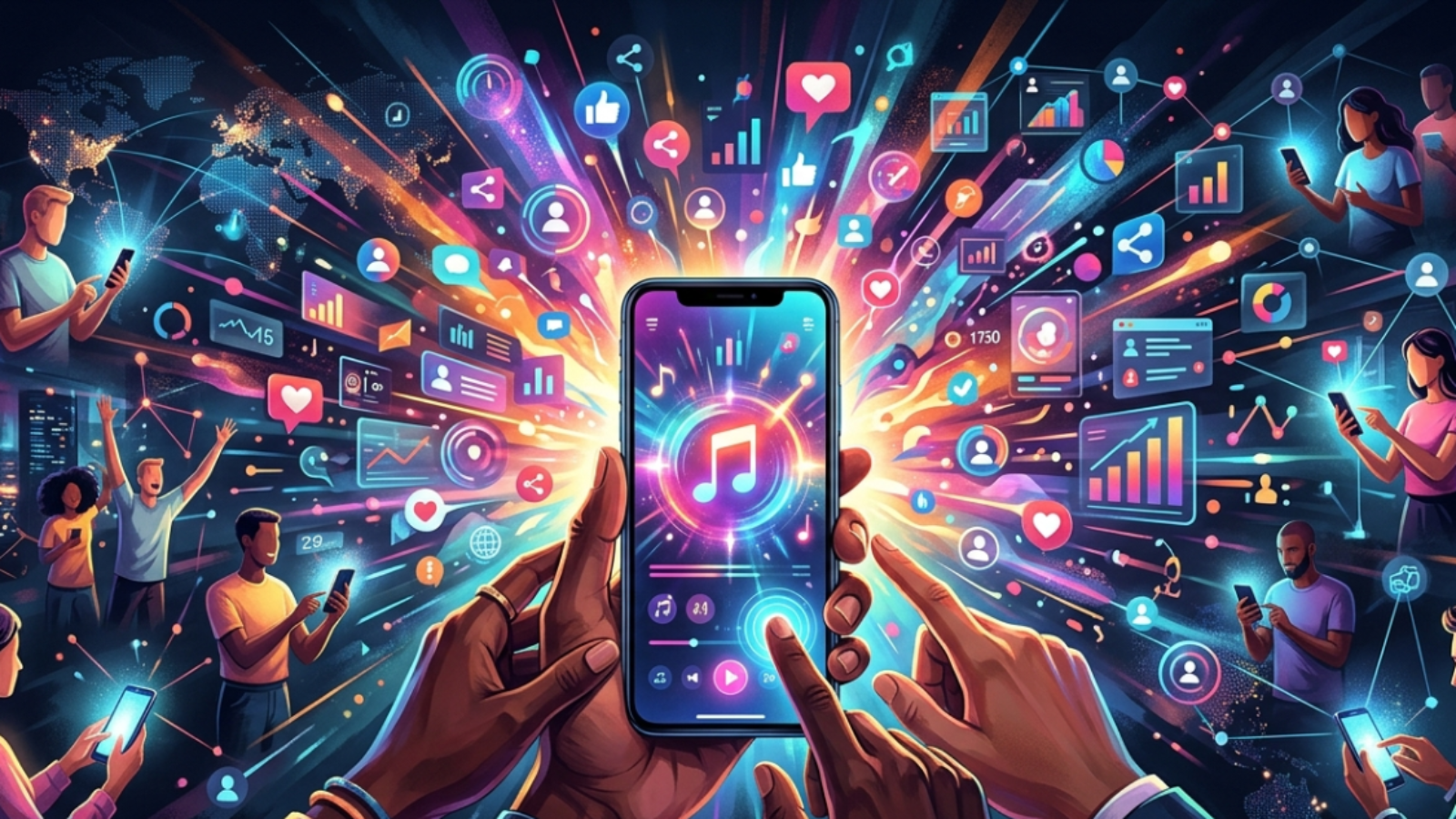
Spotify Wrapped Did Not Just Go Viral – It Rewrote the Rules of What a Marketing Campaign Can Be
Every November, millions of people voluntarily become Spotify’s most enthusiastic advertisers. They do it for free. They do it happily. And most of them do not even realise it is a marketing campaign.
The Campaign That Made People Want to Advertise Your Product
Late November arrives. Your phone buzzes. Spotify Wrapped is here. Before you have even opened the notification, you already know what is coming and you are already curious. What was your most played song this year? Which artist did you listen to more than you are willing to admit in daylight? What genre apparently defines you, according to an algorithm that has been quietly paying attention to your entire year?
You open it. You scroll through. Some of it surprises you. Some of it confirms something you already suspected about yourself. And then, almost automatically, you share it. Not because Spotify asked you to. Not because there is an incentive or a prize. But because the data told you something specific and personal about yourself and you want your people to see it.
This is what Spotify Wrapped has become. Not just a feature. Not just a campaign. A genuine annual cultural event that millions of people look forward to, participate in voluntarily, and share without any prompting from the brand. In 2026, the campaign included fifty fan destinations worldwide, installations celebrating artists like Lady Gaga and Chappell Roan in cities from Rio de Janeiro to New York, and a visual mixtape format that referenced pre-streaming music culture while being completely native to the present.
This blog is about how Spotify built one of the most sophisticated and most studied marketing campaigns in modern history, what principles make it so difficult to replicate, and what the lessons are for every brand trying to turn their product data into something their audience genuinely cares about.
The Insight That Everything Else Was Built On
Spotify Wrapped began in 2015 as a relatively modest year-end data feature. The strategic insight that turned it into a cultural phenomenon was deceptively simple: people find data about themselves deeply interesting when it reflects something true about their identity.
Music is not just entertainment. For most people, it is deeply tied to identity, memory, emotion, and self-expression. The songs you listen to on repeat during a difficult month, the album you discovered at exactly the right moment in your life, the artist whose entire discography you consumed over three sleepless nights, all of this is a record of who you were and what you were going through. Spotify has access to that record, and Wrapped turns it into a mirror.
When someone sees that they were in the top 0.1 percent of listeners for an artist they love, they do not feel surveilled. They feel seen. And the desire to share something that makes you feel seen is one of the most consistent and reliable motivations in all of human social behaviour. Spotify did not create that desire. They identified it and built a product experience around it.
Why Wrapped Works When Other Data Campaigns Do Not
The Data Is Personal Without Feeling Invasive
There is a very fine line between data that feels like a personalised gift and data that feels like surveillance. Spotify navigates this line successfully because the data in Wrapped is about your choices, your preferences, your taste, things you actively decided to do. It reflects back what you chose, not what you revealed inadvertently. This distinction matters enormously to users in an era of heightened awareness about data privacy and the ways platforms track behaviour.
The Format Is Built for Sharing
Every design decision in Wrapped is oriented toward shareability. The bold colours. The vertical card format that fits perfectly into Instagram Stories. The shareable statistics that are specific enough to be interesting but universal enough that others can relate to them. The end cards that are designed to be screenshotted. None of this is accidental. The product team designed a sharing experience that removes every possible friction between seeing your data and posting it to your story. The easier you make it for people to share, the more they will.
It Creates Social Currency
Sharing your Wrapped results is a form of self-expression and identity signalling. Your top artists tell the world something about you. The song you played most throughout the year becomes a data point about your emotional state. Even your total listening minutes reveal how important music has been in your daily life. People share Wrapped not just because it is interesting but because it says something about who they are, and that social currency motivation is far more powerful than any call to action a brand could engineer.
It Arrives at the Right Moment
Late November is a perfect timing decision. The year is almost over. People are naturally in a reflective, year-in-review headspace. The media and social landscape is already filling with best-of lists, annual summaries, and retrospective content. Wrapped arrives at exactly the moment when its format, a personal year-in-review, is most culturally resonant. The timing amplifies the concept rather than fighting against the cultural context.
The Real Challenges Behind the Magic
Wrapped looks effortless from the outside. It is not. There are genuine operational and strategic challenges that Spotify has had to navigate to keep this campaign fresh over nearly a decade.
The Expectation Problem
When a campaign becomes this anticipated, the audience arrives with high expectations and sharp critical faculties. Every year, Spotify faces the challenge of delivering something that feels new and surprising within a format that has become deeply familiar. This is genuinely difficult. The years where Wrapped felt like it was coasting on its reputation generated significantly more critical commentary than the years where the team clearly pushed the concept into new territory.
Accuracy Matters More Than With Other Campaigns
Because Wrapped is built on personal data, any inaccuracy feels like a betrayal rather than just a mistake. Users who receive Wrapped statistics that feel wrong, who see artists attributed to them that they do not remember listening to, or who notice that their real listening habits seem underrepresented, tend to react with disproportionate frustration. The data accuracy standard required for this kind of campaign is significantly higher than for conventional marketing.
It Is Very Hard to Replicate Outside of a Streaming Context
Spotify’s advantage is that music listening is inherently personal and emotionally significant. The data they collect naturally carries emotional weight. Most businesses collect data that does not have anywhere near the same emotional resonance. The number of times you clicked on a product page or the categories you browsed do not carry the same identity signal as the artists you listened to during a difficult year. Replicating Wrapped’s impact requires finding the specific slice of your product data that carries genuine personal meaning for your user, and that is a much harder creative problem than it looks.
What Other Brands Can Actually Learn From This
Find the Data That Reflects Your User’s Identity Back at Them
Every business collects some form of data about how their customers behave. The question is whether any of that data, when presented in the right way, tells the customer something meaningful about themselves rather than just about their transactions. A fitness app that shows you how many kilometres you covered this year. A reading platform that shows your most annotated books. A restaurant that shows what you ordered most often and connects it to a personality type. The insight is the same: personalised data becomes shareable when it reflects something the user recognises as true about themselves.
Design for the Screenshot Before You Design for the Dashboard
If you want your users to share their data, design the data presentation with sharing as the primary use case, not as an afterthought. What does this look like as a vertical Story card? Is the key number large enough to read in a thumbnail? Is the colour palette distinctive enough to be recognisable in a crowded feed? These are not design questions. They are distribution questions, and they should be asked at the beginning of the design process rather than at the end.
Build Anticipation Across the Year, Not Just at Launch
Part of what makes Wrapped so powerful is that users are aware throughout the year that their listening is being tracked and that a year-end summary is coming. This awareness affects behaviour and builds a year-long sense of anticipation. If you are building a similar data-driven annual moment, think about how you communicate its existence throughout the year, not just when it arrives. The anticipation is part of the experience.
Final Thoughts: The Campaign That Turned Users Into Broadcasters
The most expensive thing in marketing is attention. The most valuable thing in marketing is trust. Spotify Wrapped generates both at enormous scale without spending a proportionate amount on either because the campaign is built on something that paid advertising can never manufacture: genuine user investment in a shared experience.
When a user shares their Wrapped results, they are not promoting Spotify. They are expressing themselves. Spotify simply created the tool that made their self-expression possible. The brand benefit is a byproduct of genuine user value, and that is the model that every marketing team in the world should be studying.
Stop trying to make people talk about your brand. Start giving them something true about themselves that they want to share.
That is the campaign. Everything else is just execution.